
In short: A website builds trust and tells people who you are. A landing page gets 1 visitor to take 1 action. A funnel is the system that captures leads and follows up until they buy. Most service businesses need all 3 eventually, but if you are starting from scratch, build the one that fixes your biggest gap first.
When was the last time your website actually made you money?
Not someone complimenting it. Not a nice comment about how good it looks. An actual enquiry that turned into a paying client and money in your account.
Because if you are honest, for a lot of you your website is just sitting there. Looking nice. Existing. But not actually doing anything for your business.
And the frustrating thing is, it is probably not your website's fault. It is that nobody told you which tool was right for your business, at this stage, for this offer, for this audience.
That is what this blog is going to fix. And if you want to go even deeper, this is also the topic of Episode 15 of The EMpire Diaries: listen on Spotify, Apple Podcasts, and Amazon Music.
One month you are busy. Enquiries are coming in, you feel in demand, everything feels like it is finally working. And the next month? Nothing. Silence. And that silence starts to mess with your head.
You question your pricing. Your niche. Your content. Whether this business is even working at all.
But the truth is that inconsistency is not random. It is not because you are not good enough. It is a structural problem. You do not have a system that turns attention into income consistently.
Most of you are relying on one thing... word of mouth, referrals, or social media. And those things are not predictable. So your leads are not predictable. Which means your income is not predictable.
The shift from hoping you get clients this month to knowing exactly where your next clients are coming from comes from having 3 things working together: your website, your landing page, and your funnel. Each one has a completely different job. And this is where most women go wrong: they expect their website to do everything, and then wonder why it is not working.
Most of you are acting like the funnel. You are the one replying to everything, chasing everything, following up, answering the same questions again and again. That is bloody exhausting! And it does not have to be that way.
Your website is your organic lead generator. It is designed to be found... by people who are actively searching for a solution to a problem you solve.
Here is where most women get it wrong: they build their website based on what they want to say about their business. They are not building it with the client in mind and what the client is actually searching for.
Your ideal client is not typing "business coach" into Google. They are typing "why is my business not growing" or "how do I get more clients" or "why is my content not converting." Your website needs to meet them there. That is what SEO actually means, not just having a website, but having the right content on it that answers the questions your ideal client is searching for.
If your site does not answer those questions, it is not a lead generator. It is an online brochure. And brochures do not make you money.
Your website is powerful; when it has the right foundations in place, it becomes a high-converting lead-generating machine. But it is a long game. SEO takes time. Google takes time to rank you. Think of your website as the most powerful tool you have, but one that pays you back over months and years, not overnight.
In my experience working with women across product, service, and experience-based businesses over 13 years, the ones who see the fastest results are almost always the ones who built a focused landing page first, before investing in a full website. One client went from 0 online enquiries to 3 qualified leads in her first week, simply by stopping sending people to her homepage and building a single landing page for her core offer instead.
For a full breakdown of the 16 features every converting website needs, read my blog on why your website is not converting.
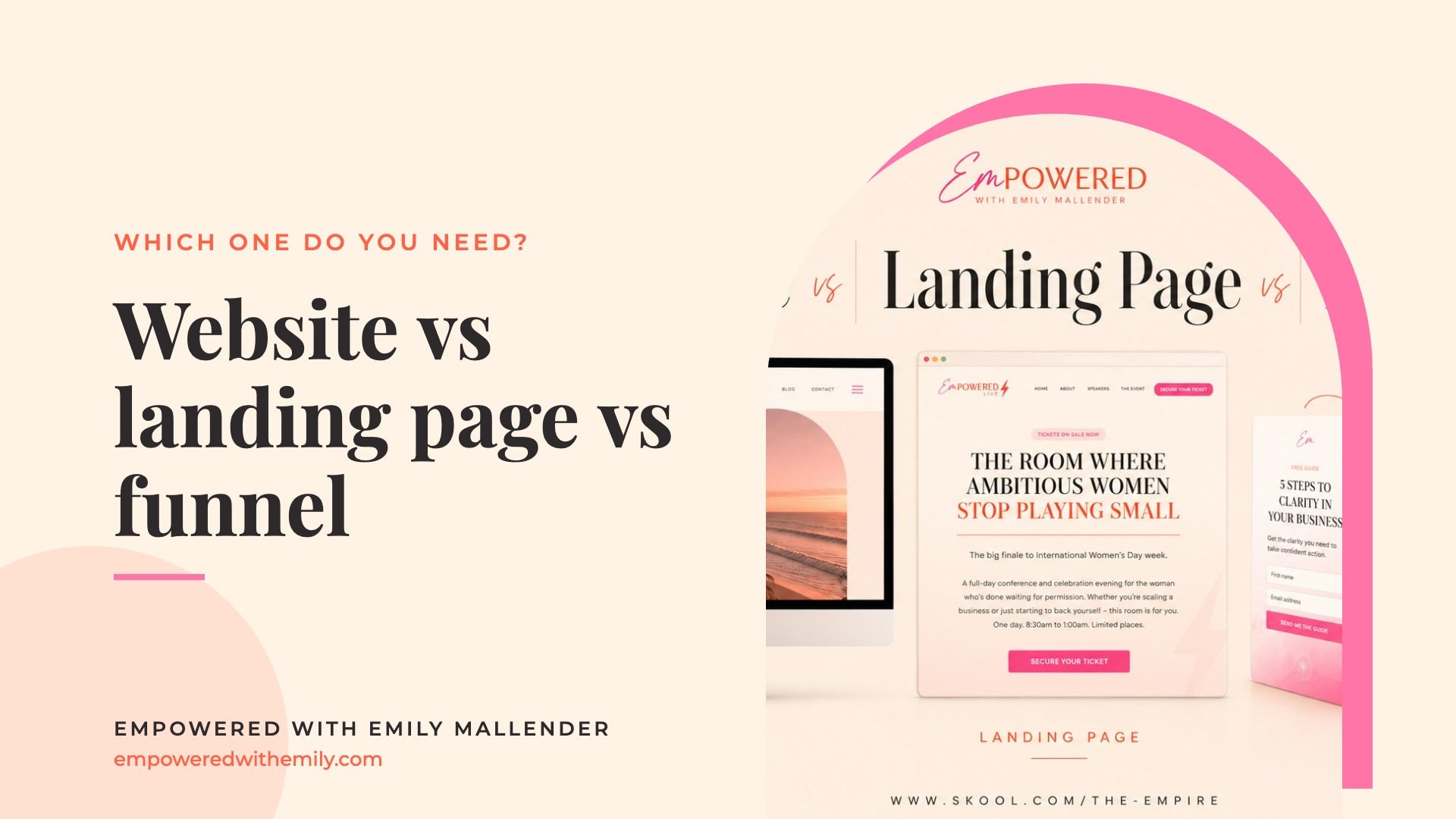
A landing page is one page, one offer, one call to action. No distractions. No navigation. No links sending people off somewhere else.
Here is something most women do not realise: most of you do not have a traffic problem. You have a conversion problem. Your content is doing its job and getting people to your website, but then they are leaving. Because when they land on your homepage, they see everything you do and they do not know where to start. So they leave. Not because they were not interested, but because you did not make it easy enough for them to say yes.
That is exactly what a landing page fixes. When someone clicks on your social media post about a specific pain point, they should land on a page that speaks to that exact pain point, with one clear solution and one clear next step. No guessing. No confusion. No friction.
Your website is your long game. Your landing page is your right now game. And landing pages are quick to build; you can have one up in a day using tools like LeadZilla.
The single most expensive mistake I see is women sending paid ad traffic to their homepage. Your homepage is not a landing page. It cannot do that job. Send paid traffic to a dedicated landing page for that specific offer every single time.
A funnel is a system and a journey. It takes a stranger and turns them all the way into a paying client without you having to manually do every single step.
Right now, most of you are the funnel. You are the one replying to every enquiry, chasing every lead, sending every reminder, answering the same questions over and over again. That is not a business. That is an exhausting job with no off switch!
A funnel automates all of that. Here is what it looks like in practice: you put out content that speaks to a specific pain point. That content drives people to a landing page. On that landing page, there is one offer and one call to action. They click it and fill in a vetting form that qualifies them - asking about timescales, budget, what they need. Only the right people get through. Then they are directed to book a call or buy directly.
From that point, automated emails start going out. Building trust. Handling objections. So by the time they get to their call with you, they already know you, trust you, and want to work with you. The funnel has done the work. Not you.
I work with clients inside Visible and Paid and through 1:1 coaching to build exactly this kind of system. The women who implement a proper funnel, with a qualifying vetting form and an automated nurture sequence, consistently report that the quality of their enquiries improves dramatically. They stop spending hours on calls with people who cannot afford them, and start showing up to conversations with people who are already sold.
This is the difference between running a business and building an asset. You can bring in more clients without it taking more of your time and energy.
A funnel is not the right first step if you are still figuring out your offer or your audience. Build the website and the landing page first. Get proof that your offer converts. Then build the funnel to scale it.
This is where everything changes. Your website brings in organic leads from Google over time. Your landing page converts your visibility into enquiries right now. Your funnel turns those enquiries into clients automatically without you chasing.
3 systems, all working together, none of them dependent on you showing up every single day.
That is what being visible and paid actually looks like.
Build a landing page first. Test whether your offer converts before you invest in anything else. A landing page takes days. A full website takes months. Get proof of concept first.
Build a full website with clear service pages, a blog that targets the questions your ideal client is Googling, and one primary call to action on the homepage. This is your long game foundation.
You need a dedicated landing page for every campaign. Never send paid traffic to your homepage.
Build a funnel. Lead magnet at the top, email nurture sequence in the middle, booking or sales mechanism at the bottom. This takes the most time to build but gives you the most freedom once it is working.
Answer this question: what is the single most important action you want someone to take in the next 30 days? Build one thing that makes that 1 action as easy as possible. Everything else can come later.
A lot of you do not need more information. You just need to make a decision. What are you building first? Pick 1 and commit to it this week.
Yes. Your social media following is rented. The platform can change the algorithm, restrict your reach, or remove your account. Your website and your email list are the only digital assets you truly own. Build both as a priority.
A basic landing page can be built for almost nothing using free tools. A professionally built landing page might cost between £300 and £1000. The copy matters far more than the design - the words are what convert, not how it looks.
A marketing funnel covers the full journey from awareness to purchase, including your organic content and social media. A sales funnel is the more specific sequence from lead capture to sale. In practice, the terms are often used interchangeably. What matters is that you have a clear sequence of steps moving someone from not knowing you exist to paying you.
Eventually, yes. But not all at once. Build in order of commercial priority. A landing page first if you need revenue now. A website for long-term authority and search traffic. A funnel once your offer is proven and you want to scale without adding more of your time.
A vetting form is a set of qualifying questions that sit between your landing page and your booking or purchase step. It asks about budget, timescales, and what the person is looking for. It filters out poor-fit enquiries before they get to your diary, so every call you take is with someone who is genuinely qualified and ready to move forward. Yes, you need one.
Yes, and it is one of the fastest ways to get one live quickly. I built a landing page recently using AI tools in a fraction of the time it would have taken manually. The key is getting the strategy and the copy right first. AI can help you build fast, but it cannot replace knowing your ideal client, your offer, and your message. Get those clear first, then use AI to build quickly.
Understanding this is one thing. Building it is another. And most women who read this and completely get it will go back to doing exactly what they were doing before. Not because they do not understand it, but because they do not act on it.
If you know you need to build this, but you also know you will not do it alone, that is exactly why Visible and Paid exists.
And if you want to hear this conversation in full, listen to Episode 15 of The EMpire Diaries on Spotify, Apple Podcasts, and Amazon Music. New episodes every Wednesday at 7am.
And if you want to meet me in person alongside hundreds of ambitious women in business, join us at EMpowered Live 2027 at the OEC Sheffield on 12th March 2027. Get your tickets here.
Find out more at empoweredwithemily.com.